11+ Tutoring: Your Child's Path to Success
Securing a place at a grammar school or independent school through the 11+ exam is a significant milestone. Our tutoring service is designed to give your child the competitive edge they need to succeed.
What my 11+ Program Offers:
Customised Learning Plan: We don't believe in a one-size-fits-all approach. Your child will begin with a thorough assessment to identify their unique strengths and weaknesses. From there, we'll build a personalized, targeted learning plan that focuses on the areas where they need the most support, ensuring every session is productive and tailored to their specific needs.
Expert Subject Mastery: The 11+ exam goes beyond the standard curriculum. Our program provides in-depth instruction across all key subjects: Verbal Reasoning, Maths, and English. We’ll equip your child with advanced problem-solving techniques, critical thinking skills, and a deeper understanding of complex topics, setting them apart from other candidates.
Proven Exam Strategies: Success on exam day is as much about strategy as it is about knowledge. We’ll teach your child essential time management techniques, effective question-solving methods, and the confidence to perform under pressure. Through regular timed practice and full-length mock exams, your child will become comfortable and confident in the exam environment.
Confidence and Resilience: The 11+ can be a stressful journey for both students and parents. Our role is to be more than just an academic guide; we are a dedicated mentor who will build your child’s confidence and resilience. We provide a supportive, positive environment that reduces anxiety and motivates them to achieve their full potential.
Investing in 11+ tutoring is an investment in your child’s future. It's about giving them the best possible chance to excel and secure their place at their chosen school.
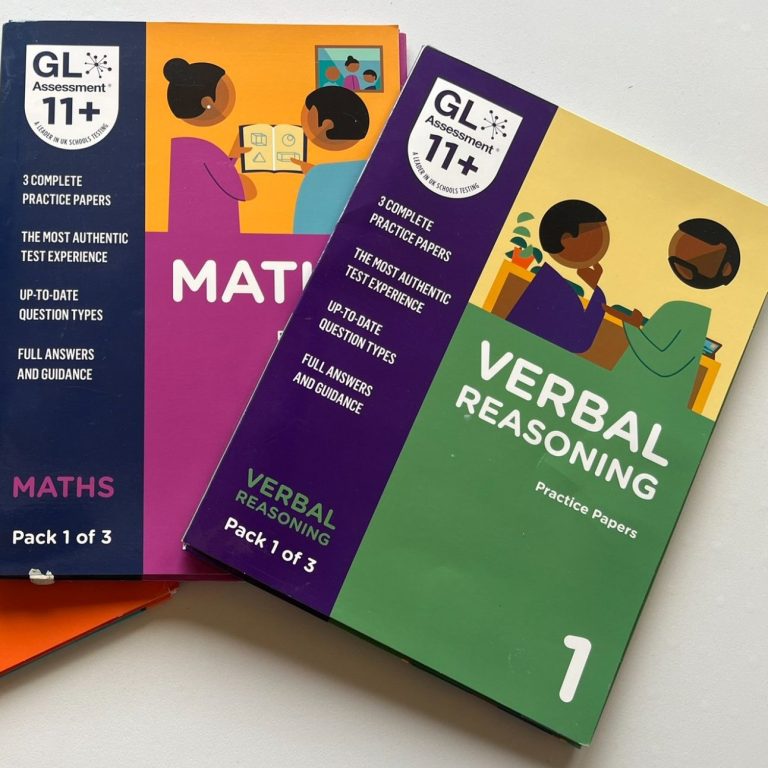
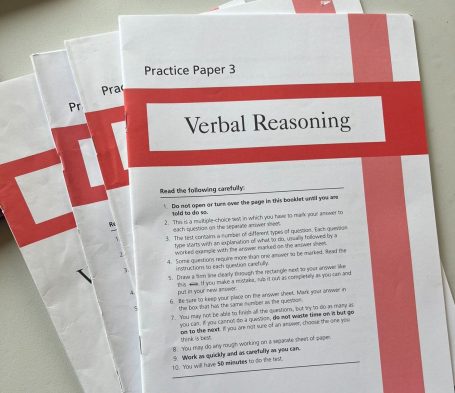
The 11+
What you might not know...
Verbal and non-verbal reasoning are key components of many entrance exams for selective schools, such as the 11+, because they test a child's natural aptitude and problem-solving skills, rather than just their learned curriculum knowledge.
Verbal reasoning
Verbal reasoning is a form of problem-solving that uses words, letters, and language. It assesses a child's ability to think critically with words, understand relationships between concepts, and follow logical instructions. These skills are often not taught directly in primary schools, which is why tutoring and practice are so important.
Typical questions involve:
Sequences: Completing a sequence of letters or numbers based on a hidden rule.
Word Codes: Deciphering a code to find the correct word.
Analogies: Finding the relationship between a pair of words and applying it to another pair (e.g., happy is to sad as big is to...).
Synonyms and Antonyms: Identifying words that have the same or opposite meanings.
Logic Puzzles: Solving puzzles based on written clues.
Non-Verbal reasoning
Non-verbal reasoning is the ability to solve problems and understand relationships using pictures, diagrams, and shapes. It tests a child's spatial awareness, visual logic, and ability to spot patterns and sequences without relying on language.
Common question types include:
Sequences: Identifying the next shape in a series or finding the missing shape.
Matrices: Completing a grid of shapes by identifying the rule that applies across the rows and columns.
Odd One Out: Finding the shape that does not fit with the others in a group.
Rotations and Reflections: Mentally rotating or flipping a shape to find the correct answer.
Nets and Cubes: Visualising how a 2D net will fold into a 3D shape, such as a cube.
Test Breakdown
Mathematics
Duration: 50 minutes
Details: The test is based on the Key Stage 2 National Curriculum, covering most of the content up to Level 5. It also includes some more challenging questions aimed at Level 6.
English
Duration: 45 minutes
Details: This paper is designed to assess your child's comprehension, vocabulary, and punctuation skills.
Verbal Reasoning
Duration: 50 minutes
Details: This test analyses your child's academic potential and helps to identify their individual strengths and weaknesses. The paper has been created to be taken without any prior knowledge, and it includes an integral practice element.
How to apply for the tests
The Application Process
Applying for the 11+ is a two-step process that can be a little confusing because it involves both the individual schools or consortiums and your local authority. It is crucial to check the specific deadlines and procedures for the schools you are interested in, as they vary significantly across the UK. For Bournemouth and Poole, it is as follows:
The specific application process for the grammar schools in Bournemouth and Poole is managed by a consortium of four schools: Bournemouth School, Bournemouth School for Girls, Poole Grammar School, and Parkstone Grammar School. This means the application process is streamlined as they all use the same test.
1. Consortium-Wide Entrance Test
One Test for All Four Schools: The main advantage is that your child only needs to sit one set of entrance tests, which are used by all four grammar schools. You will register your child with just one of the schools, and the test results will be shared with the others.
Test Subjects: The exam is provided by GL Assessment and typically includes papers in English, Mathematics, and Verbal Reasoning. All the tests are multiple-choice.
2. The Two-Part Application
The process is a dual application, requiring you to complete two separate but essential steps.
Step A: Registration for the Test
You must register your child directly with one of the four consortium grammar schools. This is usually done through an online form on the school's website.
There is a specific registration window, which typically opens in April and closes in early September (4th September 2026). You must meet this deadline to be eligible for the main testing date.
Step B: Common Application Form (CAF)
Regardless of whether you have registered for the test, you must also apply for a school place through your local authority, Bournemouth, Christchurch and Poole (BCP) Council.
You will list your preferred schools on the CAF in your order of preference, including the grammar school(s) you are applying to.
The national deadline for submitting this form is 31st October in the year before your child is due to start Year 7.
Key dates for entry in 2027:
- Monday 13th April 2026: Registration opens
- Friday 4th September 2026: Registration deadline (12:00 noon)
- Deadline for Access Arrangements forms is roughly a week later
- Saturday 26th September 2026: 11+ Entrance Test Day
- October 2026: Results are typically issued
- Saturday 31 October 2026: Deadline to apply for school places via the local authority
Crucial Advice:
You must complete both steps. If you register for the test but do not list the school on your CAF, your child will not be considered for a place. Likewise, if you list the school on your CAF but your child has not registered for and taken the test, their application will be invalid.
Late Applications: There is a process for late applications, but these are only considered after all on-time applications have been processed, significantly reducing your child's chance of securing a place.
Passing the Test vs. Getting a Place: Achieving the pass mark makes your child eligible for a place, but it does not guarantee one. Places are allocated based on specific oversubscription criteria, which often give priority to factors such as Pupil Premium eligibility, living within the school's priority area, and finally, the child's score in the test.
Admissions | Parkstone Grammar School, Poole, Dorset, UK
Admissions | Year 7 | Poole Grammar School
Admissions – Bournemouth School For Girls
Admissions - Bournemouth School